
How to Track Ovulation with Irregular Periods: A Comprehensive Guide for 2026


Did you know that research from Natural Cycles involving over 600,000 cycles found that only 13% of women actually have a "perfect" 28 day cycle? If your dates vary every month, you've probably felt the sting of wasting a $25 Walgreens predictor kit or the anxiety of an app telling you your fertile window passed days ago. It's incredibly frustrating to feel like your own body is a moving target when you're trying to plan for the future.
The good news is that you don't need a predictable calendar to find your peak fertility. You can master how to track ovulation with irregular periods by ditching generic algorithms and focusing on your unique biological signals instead. This guide reveals the exact testing strategies and hormonal patterns needed to identify your fertile window with total confidence. We'll break down the latest 2026 technology, from multi-hormone monitors like Inito to progesterone tracking, to help you build a reliable system that reduces stress and puts you back in control of your reproductive health.
Key Takeaways
- Learn why the standard "Day 14" logic fails for irregular cycles and how to define your specific hormonal window.
- Discover how to track ovulation with irregular periods using a sympto-thermal approach that combines multiple biological signals for higher accuracy.
- Apply the "Shortest Cycle Rule" to determine the precise day to begin testing, saving you time and expensive test strips.
- Identify common pitfalls, such as testing at the wrong time of day or with diluted urine, that lead to false negatives.
- Master the transition from tracking to acting once your fertile window is identified to maximize your chances of success.
What Defines an Irregular Cycle and Why Tracking Matters
Many women are told that a 28-day cycle is the gold standard, but for millions, that is far from reality. A cycle is clinically irregular if the length varies by more than 7 to 9 days between months. If your period arrives on day 24 one month and day 35 the next, you aren't alone. This fluctuation is often tied to conditions like Polycystic Ovary Syndrome (PCOS), thyroid imbalances, or high cortisol levels caused by chronic stress. According to the Office on Women's Health, about 10% of women aged 15-44 have difficulty getting pregnant, and cycle irregularity is often the first sign of a hormonal hurdle. It's incredibly frustrating when standard period apps constantly send "ovulation today" alerts that don't match what your body is actually doing.
These apps use simple averages that fail for anyone outside the "normal" range. Relying on them often leads to missing the fertile window entirely or wasting expensive testing kits on the wrong days. Knowing how to track ovulation with irregular periods means shifting your focus away from the calendar and toward your actual hormonal shifts.
To better understand this concept, watch this helpful video:
The Biology of Ovulation vs. The Calendar
Think of your cycle as having two distinct halves. The luteal phase, which is the time between ovulation and your next period, is usually very stable. However, the follicular phase; the time it takes for your body to prepare an egg; is highly sensitive. This is where the irregularity happens. Because the process of ovulation is a biological event triggered by a surge in Luteinizing Hormone (LH), it doesn't follow a strict schedule. You can even have "hidden" ovulation during a very long cycle, meaning you could be fertile even if you haven't seen a period in weeks. Relying on physical data rather than dates is the only way to catch these moments.
Why Accurate Tracking is Your Best Fertility Tool
When you stop guessing, you start gaining control. Identifying your unique fertile window, which typically spans the five days leading up to egg release, is the most effective way to improve your chances of conception. This data is also invaluable for your medical team. Instead of telling your doctor your periods are "unpredictable," you can show them specific charts of your LH surges and temperature shifts. This evidence helps fast-track a diagnosis if there is an underlying hormonal issue. Understanding how to track ovulation with irregular periods also reduces the burnout caused by "timed intercourse." When you know exactly when your window is open, you can focus your energy on the days that actually matter. Using an ovulation calculator can help you estimate your start dates, but your physical symptoms will always provide the real-time accuracy you need.
The 3 Most Reliable Methods for Tracking Irregular Ovulation
Relying on a single data point is often the biggest mistake when learning how to track ovulation with irregular periods. Standard smartphone apps that guess your fertile window based on your last three cycles are simply using math, not your actual biology. If your cycle varies, these algorithms will eventually lead to missed opportunities. Instead, 2026 fertility experts recommend a "Sympto-Thermal" approach. This method involves combining multiple physiological signals into one comprehensive chart. By cross-referencing different data points, you eliminate the guesswork and can identify your window even if it shifts by two weeks. Consistency is your best tool; you must track these signals at the same time every day to see the true hormonal patterns emerge.
Cervical Mucus (CM) Monitoring
Estrogen levels rise significantly as your body prepares to release an egg. This hormonal shift changes your cervical mucus from a "dry" or "sticky" consistency to something slippery and clear. You can check this easily by observing the mucus on your toilet tissue after wiping. "Egg-white" cervical mucus (EWCM) is the gold standard for fertility. It creates a protective, nutrient-rich environment that helps sperm survive for up to five days inside the reproductive tract. It's one of the most effective methods to track when you're ovulating because it signals the start of your fertile window before the egg is actually released.
Basal Body Temperature (BBT) Charting
Basal Body Temperature is your lowest body temperature in a 24-hour period. To track this accurately, you need a specific basal thermometer that measures to two decimal places. You must take your temperature immediately upon waking, before you even sit up or reach for your phone. After ovulation, your body releases progesterone, which causes a slight but distinct temperature spike of about 0.5 to 1.0 degree Fahrenheit. While BBT is excellent for confirming that ovulation actually occurred, it doesn't predict it in advance. It serves as the "look back" tool that proves your other symptoms were accurate.
Ovulation Predictor Kits (OPKs) and LH Surges
Ovulation Predictor Kits detect Luteinizing Hormone (LH) in your urine, which typically surges 24 to 48 hours before egg release. The FDA regulates these tests as medical devices and notes they are reliable in about 9 out of 10 cases when used correctly. If you have PCOS, you might experience "false starts" where LH rises but ovulation doesn't follow. This is why knowing how to track ovulation with irregular periods requires using OPKs alongside temperature and mucus checks. Newer 2026 options, like the Proov kit, also allow you to test for progesterone metabolites to confirm the surge was successful. Using a fertility-friendly lubricant during these peak LH days can provide extra support as you navigate your unique cycle.
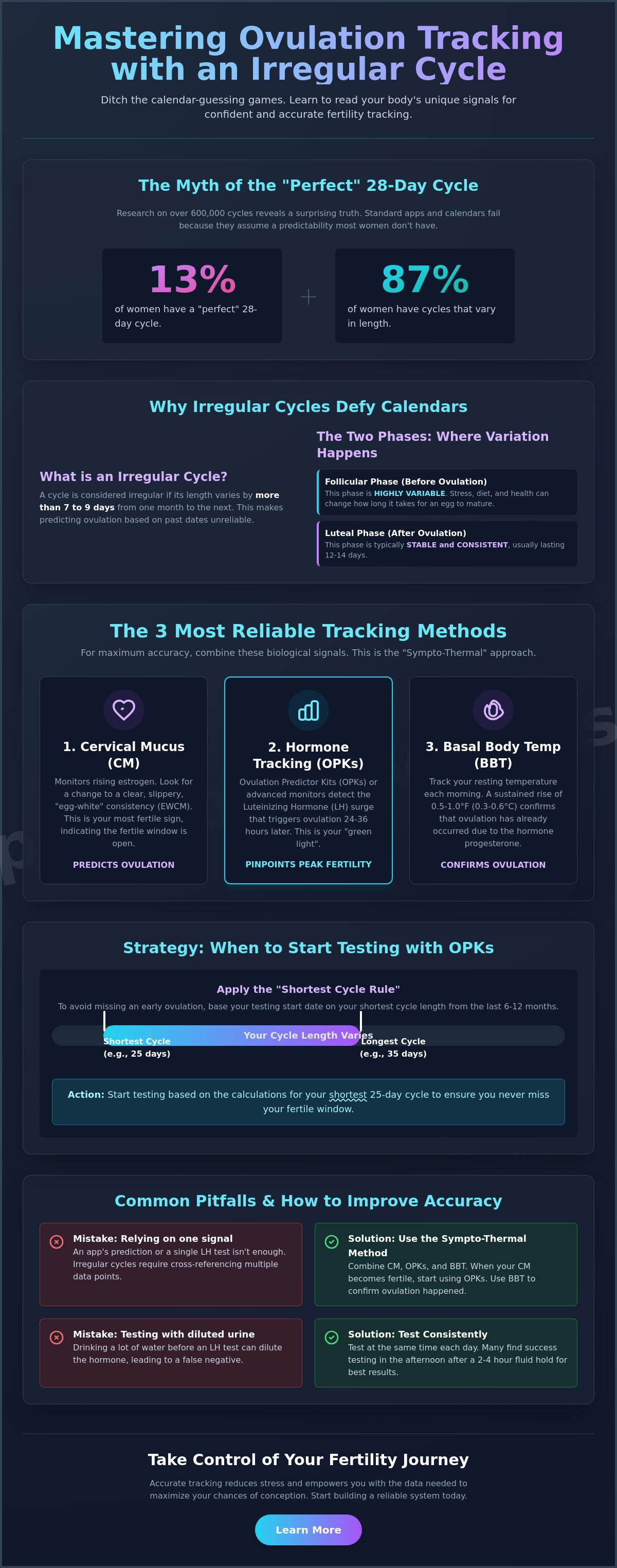
Strategy: When to Start Testing When Your Cycle Length Varies
The most common mistake women make when learning how to track ovulation with irregular periods is relying on the "average" length of their past cycles. If your cycle ranges from 28 to 40 days, an average of 34 days is mathematically correct but biologically useless. If you start testing based on that average, you will likely miss the fertile window in your shorter months. To catch every possible opportunity, you must use the "Shortest Cycle Rule." This strategy ensures you're already monitoring your hormones before the earliest possible egg release occurs.
The American Society for Reproductive Medicine offers detailed insights into various Ovulation Detection Methods, highlighting that timing must be adapted to individual variability. To find your personal start date, look at your cycle history from the last six months and identify your shortest cycle. Subtract 17 days from that total. For example, if your shortest cycle was 27 days, you should begin testing on Day 10. This proactive approach covers your bases even when your body decides to ovulate earlier than expected.
Step-by-Step Testing Protocol
Consistency is vital once you reach your calculated start day. Begin by testing your urine once daily, ideally in the early afternoon when LH concentrations are typically highest. As you observe your cervical mucus transitioning to a slippery, clear consistency, increase your testing to twice a day. Because an LH surge can sometimes last less than 12 hours, testing at 11:00 AM and again at 7:00 PM helps ensure you don't miss the peak. Continue this protocol until you record a clear peak on your OPK and see the sustained temperature rise in your BBT chart that we discussed earlier.
Cost-Saving Tips for Long Cycles
Tracking for cycles that last 40 days or longer can quickly become expensive if you're using high-end digital tests every day. To manage this, many women use affordable "dip-and-read" paper strips for their baseline daily monitoring. These are effective for catching the start of a surge without the high price tag. You can then save your more advanced fertility bundles or digital monitors to confirm the peak once the strip shows a darkening line. If you hit a long "dry" patch where your mucus remains sticky and your OPKs stay faint, it's okay to take a two-day break from testing to avoid burnout, provided you stay alert to any physical changes in your body. Mastering how to track ovulation with irregular periods is a marathon, not a sprint, so preserving your mental energy is just as important as the data itself.
Common Pitfalls and How to Improve Your Accuracy
Even the most diligent tracking can be derailed by small environmental factors or biological quirks. One of the most common issues is diluted urine. Many people assume first morning urine is best for all tests, but for Luteinizing Hormone (LH), the afternoon is often superior. This is because LH is typically synthesized in the morning and takes several hours to appear in your urine at detectable levels. If you drink a large amount of water and test shortly after, the hormone concentration might be too low for the test to pick up, even if you're actually surging. This leads to frustrating false negatives when you're trying to learn how to track ovulation with irregular periods.
Medications also play a significant role in your results. If you're taking ovulation-inducing drugs like Clomid or Letrozole, they can cause your OPKs to show false positives early in your cycle. Always follow your doctor's specific timing for testing when on these prescriptions. Similarly, your Basal Body Temperature is highly sensitive. A single glass of wine, a restless night, or a mild cold can cause a temperature spike that looks like ovulation but is actually just a physiological reaction to stress or inflammation. These "noisy" data points can make a chart look much more confusing than it needs to be.
Identifying 'False Starts' in PCOS
For those with Polycystic Ovary Syndrome, the body often attempts to ovulate multiple times before it succeeds. You might see a "high" reading on an OPK, only for your temperature to stay flat and your cervical mucus to remain creamy. This is a false start. To avoid getting fooled, always look for the "triple threat" of symptoms: a peak LH test, clear egg-white cervical mucus, and a confirmed BBT rise. In 2026, many women also use progesterone (PdG) strips to confirm that an egg was actually released. Progesterone only rises after successful ovulation, providing the final "receipt" your body needs to stop testing for the month.
Optimizing the Tracking Environment
To get the most accurate results, implement a 2 to 4 hour "liquid hold" before you test. This allows the LH to reach a high enough concentration in your bladder. You should also avoid comparing the darkness of a line on one brand of test strip to a different brand, as their sensitivity levels vary. A peak is specifically defined as the first day the test line is at least as dark as, or darker than, the control line. If you're ready to move from data collection to active trying, using a fertility-friendly lubricant can help support sperm motility during those critical peak days. Mastering how to track ovulation with irregular periods requires patience, but avoiding these common pitfalls will save you both time and money.
Optimizing Your Fertility Journey with Conceive Plus
Once you have mastered how to track ovulation with irregular periods, the focus shifts from data collection to active conception. Identifying your fertile window is a major milestone, but it's only the first half of the equation. The environment in which sperm and egg meet is just as critical as the timing itself. When your charts indicate that an LH surge is imminent or your cervical mucus has transitioned to a fertile consistency, you need to ensure your body has the right support to make the most of those high-fertility days.
Transitioning from "tracking" to "acting" requires a shift in mindset. Instead of just observing your biological signals, you are now actively facilitating the best possible conditions for pregnancy. This involves using professional tools that complement your home tracking data and ensuring that no external factors, like standard lubricants, interfere with your progress.
Supporting Conception During Your Fertile Window
Many couples don't realize that standard, over-the-counter lubricants can actually hinder their chances of success. Most traditional lubricants have a pH that is too acidic for sperm or contains thickeners that act as a barrier to motility. During your peak days, your body naturally produces "egg-white" cervical mucus to protect and transport sperm. Using a fertility-friendly lubricant is essential because it is specifically formulated to mimic these natural fluids. It provides the correct pH and electrolyte balance to help sperm reach the egg safely. You can use the data from an ovulation calculator as a baseline to know when to start incorporating these supportive products into your routine.
Comprehensive Tools for Your Journey
A successful journey often requires more than just a single test kit. For many, 2026 has brought a more holistic approach to reproductive health that includes both partners. Exploring fertility products and bundles can provide a streamlined way to manage your tracking and support needs simultaneously. These bundles often include high-sensitivity OPKs alongside supplements designed to support hormonal balance. It is also wise to check for special offers on tracking kits to ensure you have a steady supply for those longer, more unpredictable cycles.
Knowing how to track ovulation with irregular periods also empowers you to know when it is time to seek professional help. If your tracking consistently shows anovulation; which is a lack of a temperature spike or LH surge over several months; take those charts to a fertility specialist. Having three to six months of detailed data allows your doctor to skip the guesswork and move straight to a diagnostic plan. Whether you are adjusting your lifestyle or preparing for medical intervention, your data is the most powerful tool you own.
Take Control of Your Fertile Window
Navigating an unpredictable cycle doesn't mean you're left in the dark. By mastering the "Shortest Cycle Rule" and combining biological signals like basal body temperature and cervical mucus, you can finally stop guessing. Learning how to track ovulation with irregular periods is about shifting from a calendar-based approach to a symptom-first strategy. This data doesn't just help you time intercourse; it provides a clear window into your overall hormonal health that you can share with your doctor.
As you move from tracking to trying, ensure your body has the support it needs to succeed. Conceive Plus is a doctor-recommended fertility brand used by millions of couples worldwide. Our clinically tested fertility-friendly formula is designed to mimic natural fluids and support sperm motility during your most critical days. Shop Conceive Plus Fertility Bundles to support your journey and give yourself the best possible chance of success. You have the tools and the knowledge to move forward with confidence. Your path to parenthood is unique, and with the right data, you're ready for the next step.
Frequently Asked Questions
Can I still get pregnant if my periods are irregular?
Yes, you can absolutely get pregnant with irregular cycles. Irregularity simply means your egg release happens on a different timeline each month rather than a fixed schedule. If you are ovulating, even if it happens on Day 45, you are fertile. The challenge is identifying that specific window so you don't miss the opportunity. Using physical symptoms rather than calendar dates makes conception much more likely.
What is the best ovulation test for irregular periods?
The best choice for unpredictable cycles is a monitor that tracks multiple hormones, such as estrogen and LH. These devices provide a wider fertile window than standard strips. For those learning how to track ovulation with irregular periods, using a digital monitor like Inito or a progesterone-confirming kit like Proov can help distinguish between a minor hormonal fluctuation and a true, successful LH surge.
How many days after my period ends should I start testing if my cycle is unpredictable?
You should start testing based on your shortest cycle from the last six months. Subtract 17 days from that total length to find your start day. For example, if your shortest cycle was 26 days, you'll begin testing on Day 9. This ensures you catch an early ovulation even if your next cycle ends up being much longer. Starting early prevents the frustration of missing a surprise early window.
Why does my ovulation app keep changing my fertile window dates?
Most apps rely on mathematical averages from your previous cycles to predict the future. When your body doesn't follow a strict 28-day pattern, the app's algorithm must constantly recalculate based on your latest data entries. This is why physical signs like cervical mucus and basal body temperature are much more reliable than an app's predicted "fertile days" when you are dealing with significant hormonal fluctuations.
Can stress cause an LH surge without actual ovulation?
Stress doesn't cause a random LH surge, but it can cause your body to "attempt" ovulation multiple times. You might see a rise in LH that doesn't result in egg release because high cortisol levels interrupted the process. This is often called a false start. This is exactly why confirming ovulation with a basal body temperature spike is so important for those with high-stress lifestyles or irregular cycles.
Is it possible to ovulate twice in one irregular cycle?
No, you cannot ovulate at two distinct times several days or weeks apart in a single cycle. While you can release two eggs at once; which is how fraternal twins occur; this happens within a single 24-hour window. Once progesterone rises after the first egg is released, it effectively shuts down the ovulation process for the remainder of that cycle to protect a potential pregnancy.
What should I do if I never see a 'peak' on my ovulation tests?
If you never see a peak, you may have a very short LH surge that you're missing between tests. When learning how to track ovulation with irregular periods, try testing twice a day, specifically in the afternoon and early evening. If you track for three consecutive months without a single peak or a confirmed temperature rise, it's time to consult an OBGYN to check for anovulation.
Does 'egg-white' cervical mucus always mean I am about to ovulate?
Egg-white cervical mucus is a strong indicator of high estrogen, which usually signals that ovulation is near. However, it isn't a 100% guarantee of egg release. Your body can produce fertile mucus as it prepares to ovulate, but if the LH surge doesn't follow, the egg won't be released. You should always cross-reference your mucus patterns with LH tests and temperature tracking for the most accurate results.


